
Incoterms: An Insight into These Widely Used Terms
In the complex world of international trade and logistics, clear communication and standardized terms are essential to ensuring smooth transactions and successful deliveries. This is where incoterms come into play. International commercial terms are a set of internationally recognized terms that define the responsibilities of the sellers and buyers in a trade. In this blog, we will delve into the types of incoterms and why these incoterms are important.
Importance of these terms
Clarity and Consistency: Incoterms provide a uniform language that reduces misunderstandings and brings clarity to the contracts. Both parties can refer to the same set of terms, ensuring they are on the same page regarding their roles and obligations.
Risk Allocation: By clearly outlining when risk and ownership of goods transfer from the seller to the buyer, Incoterms help manage potential disruptions, damages, or losses during transit.
Cost Distribution: Incoterms allocate various costs such as transportation, insurance, and duties between the parties, preventing disputes and ensuring transparency.
Global Standardization: In an increasingly interconnected world, having a standardized set of terms is crucial for efficient trade. Incoterms are recognized and understood across different countries and legal systems.
Types of incoterms
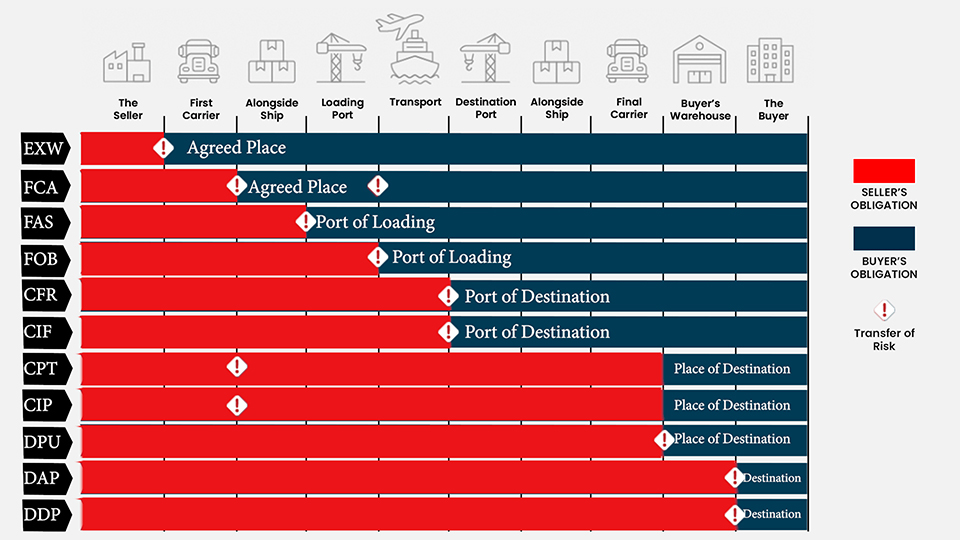
EXW(Ex Works)- The seller's responsibility is to make the goods available for pickup at their premises. The buyer bears all costs and risks from that point onwards. This term places the maximum obligation on the buyer and the minimum obligation on the seller.
FCA(Free Carrier)- The seller delivers the goods to a carrier or another person specified by the buyer at a designated place. The risk transfers to the buyer at this point. If delivery occurs at the seller's premises or at any other location that is under the seller's control, the seller is responsible for loading the goods on to the buyer's carrier. However, if delivery occurs at any other place, the seller is deemed to have delivered the goods once their transport has arrived at the named place; the buyer is responsible for both unloading the goods and loading them onto their own carrier.
CPT(Carriage Paid To)- The seller arranges and pays for transportation to the named destination. The risk transfers to the buyer upon delivery to the carrier.
CIP(Carriage and Insurance Paid To)- It is very similar to CPT, but the key difference CIP has is that the seller also provides insurance against the buyer's risk of loss or damage during transportation.
DAP(Delivered at Place)- The seller is responsible for delivering the goods to a named place of destination. The buyer takes over the goods and assumes risk after they reach the airport or destination port.
DPU(Delivered at Place Unloaded)- The seller is responsible for not only delivering but also unloading the goods at the named place of destination. All charges after unloading (for example, import duty, taxes, customs, and on-carriage) are to be borne by the buyer. However, it is important to note that any delay or demurrage charges at the terminal will generally be for the seller's account.
DDP(Delivered Duty Paid)- This term places the most amount of responsibility on the seller. The seller is responsible for delivering the goods to the buyer's premises and covering all costs associated with the shipment, including transportation, insurance, and customs clearance.
FOB(Free on Board)- This term is used for goods that are shipped by sea or inland waterway transport. The seller is responsible for loading the goods onto the ship and clearing the goods for export. The buyer assumes responsibility for the goods once they are on board the ship.
FAS(Free Alongside)- This term is similar to FOB, but it is used for goods that are not containerized. The seller is responsible for delivering the goods to the port and placing them alongside the ship. The buyer assumes responsibility for the goods once they are alongside the ship.
CIF(Cost Insurance and Freight)- This term requires the seller to cover the cost of transportation and insurance. The seller is responsible for delivering the goods to the port of destination, and the buyer is responsible for customs clearance and any additional costs associated with the shipment.
CFR(Cost and Freight)- This term is similar to CIF, but the buyer is responsible for arranging and paying for insurance.
Conclusion
Incoterms play a pivotal role in facilitating global trade by establishing a common ground for understanding between buyers and sellers. These standardized terms enhance communication, mitigate risks, and ensure a seamless flow of goods across borders. By getting a clear understanding of these Incoterms, businesses can eradicate miscommunication and bring clarity to their roles and responsibilities.